The core of the industrial drone energy system is to address short endurance, weak payload, poor environmental adaptability, and slow recharging four major pain points. The current mainstream solutions are divided into pure lithium electricity, hydrogen fuel cells, solar/multi-hybrid, and solid-state batteries four main approaches, tailored to different operational scenarios.
1. Pure Lithium Battery System (Current Mainstream)
Technical Architecture:High-energy lithium polymer/iron phosphate battery + BMS intelligent management + brushless motor
Core Parameters:Energy Density 200–300 Wh/kg, Endurance 30–60 minutes
Advantages:Mature technology, low cost, zero emissions, fast response, and low noise
WeaknessesShort battery life, significant performance degradation in low temperatures (-20℃ reduces by 30%+), charging takes 1–2 hours
Applicable Scenarios:Short-distance patrols, aerial photography, surveying and mapping, small-scale logistics (tasks under 1 hour)
2. Hydrogen Fuel Cell System (Primary for Long Endurance)
Technical Architecture:Hydrogen fuel cell stack + hydrogen storage tank + lithium battery assistance (hybrid) + intelligent energy management
Hydrogen-Lithium Hybrid:Lithium batteries handle takeoff/climbing (instantaneous high power), while hydrogen fuel cells provide cruising (stable power supply)
Range: 2–4 hours (100%+ improvement), refueling time: 3–5 minutes
Pure Hydrogen Fuel Cell:Range: 3–5 hours, energy density 3 times that of lithium batteries
Advantages:Extreme cold (-40°C)/high-altitude stability, zero emissions, fast refueling
Applicable Scenarios:Power/wind power inspection, border patrol, forest fire prevention, long-distance logistics
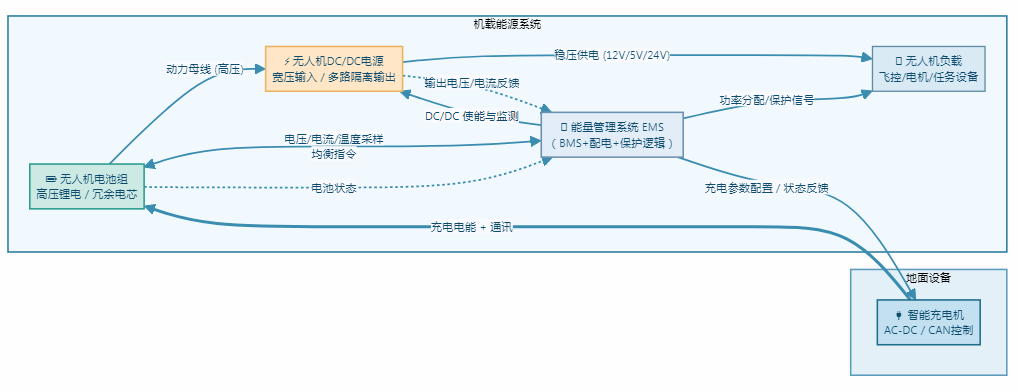
III. System Block Diagram:

Global leading supplier of intelligent power platform



Address: Building 9, COFCO Robotics Technology Park, Fuhai, Bao'an District, Shenzhen, Guangdong Province
Website: http://www.huadazhilian.com/
Phone: 400-803-8911
Mobile: 15766089813
Eamil: sales2@huadazhilian.com